Rome Wasn’t Built in a Day. But It Still Has to Keep Moving.
A conversation with Eugenio Patanè, Deputy Mayor for Sustainable Mobility and Transport of Roma Capitale on transforming mobility in one of Europe’s most complex cities.
Rome has nearly 2,800 years beneath its streets. Every era has left a layer, and every new decision must find its place among them. The challenge today is how to move a modern metropolis through a landscape that was never designed to be one.
Yet something has shifted. Over the past several years, Rome has embarked on a major urban mobility transformation: redesigning public space and introducing lower speed limits in the historic centre; advancing metro and tram development; reorganizing shared mobility; and increasingly using data and artificial intelligence to manage the city. Together, these are structural choices about what kind of city Rome intends to become.
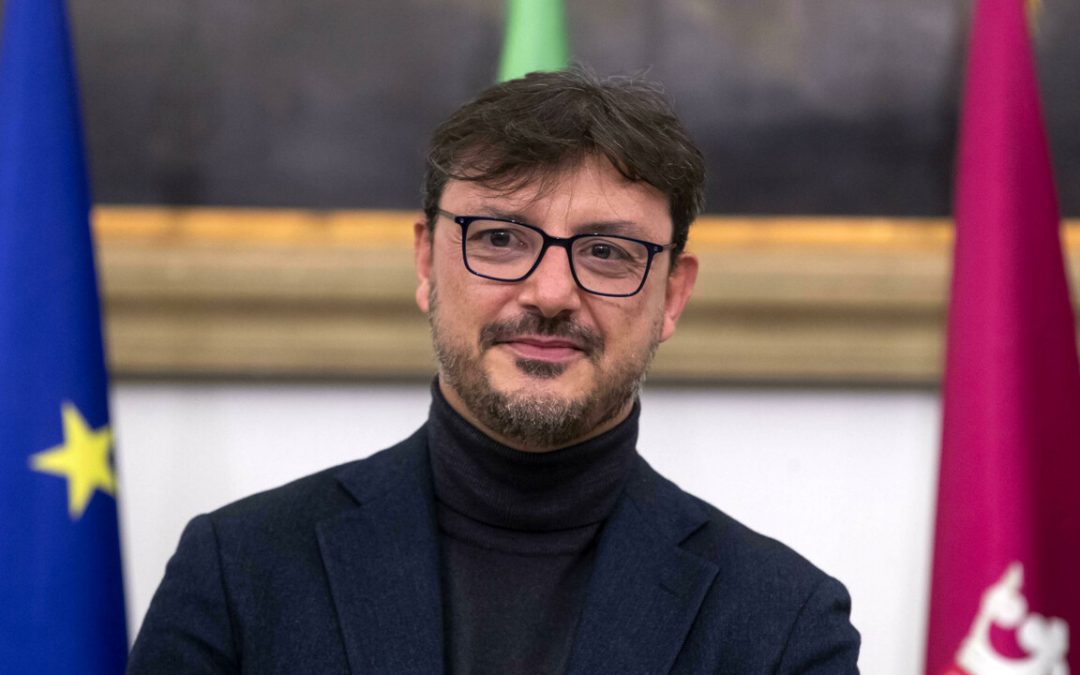
In this conversation, Eugenio Patanè, Deputy Mayor for Sustainable Mobility and Transport of Roma Capitale, speaks with Svetlana Tesic, co-founder of Mayors of Europe, about what it takes to move and transform one of Europe’s most complex cities. Patanè also serves as Vice-Chair of the Eurocities Mobility Forum and Chair of the POLIS Capitals Working Group.
Governing any metropolis today is complex. But there is no metropolis quite like Rome. What does it take to govern and transform a city of this scale, history and complexity?
Rome is, I think, one of the most difficult cities in the world to govern. It is almost 2,800 years old and contains many cities within it.
We have the archaeological city in the historic centre, which is a UNESCO World Heritage Site. Beyond that, we have the nineteenth-century city, with its large boulevards; the twentieth-century city, built after the Second World War; and then the more recent city.
Another distinctive characteristic is that 63% of Rome’s territory is green. There is countryside, agricultural land, parks and villas, while only 37% is built. This gives us a very low population density. If you compare Rome with London, the difference in area is not very large. London covers approximately 1,500 square kilometers and Rome around 1,300. The real difference is population density: London has around 8.9 million inhabitants, while Rome has 2.8 million. This creates a very different urban organization. At the edges of Rome, we have what are effectively small towns: one may have 10,000 residents and another 20,000. Together, they form a very extensive urban sprawl. This makes delivering public services, from public transport to waste management, particularly difficult. Rome is about seven times the size of Milan and roughly twelve times the size of Paris. Its territorial scale, layered history and dispersed population make it especially complex to govern and manage.
Throughout the year, Rome hosts millions of people for many different reasons. How do you plan mobility for both the expected and the unexpected?
This is another major challenge. In addition to the 2.8 million residents, around 700,000 additional people use the city and its services every day, including commuters from the metropolitan area and other parts of the region. Then there are the tourists. Visitor flows are particularly concentrated between Easter and the end of July, then again in September and October, and finally in December. Rome records tens of millions of tourist presences each year, but numbers alone do not explain the operational challenge.
Rome hosts Italy’s principal national institutions, major international institutions, the Constitutional Court and the country’s highest judicial bodies. National demonstrations and major cultural and sporting events also take place here.
We therefore receive many different kinds of visitors: religious pilgrims coming to the Vatican, people attending major sporting and cultural events, demonstrators and institutional visitors. Each group places different demands on the city and its transport system.
The Jubilee of 2025 is a good example. We managed it not only as an event, but as an opportunity to create a legacy that Rome could carry into the future. At the same time, we had to manage something nobody could have planned for: the election of a new Pope. Some situations are impossible to anticipate. During the Jubilee, there was a procession involving images of the Virgin Mary brought from around the world. One of the most imposing came from Málaga: its monumental processional structure stood around seven meters high. It could not pass beneath the tram’s overhead power lines, so we had to dismantle part of the electrical infrastructure to allow it through. Tram services remained suspended for eight days.
This illustrates why mobility planning in Rome is not only about the number of people arriving. It must also account for the nature and unpredictability of the events the city is required to accommodate.
Rome is unique, and its experience may not be directly transferable to every city across Europe. Yet there is a powerful leadership lesson in governing a city of such complexity: if change is possible in Rome, it is possible elsewhere too. What can other city leaders learn from Rome?
Some parts of our experience can certainly be shared, but Rome operates under conditions that are difficult to compare directly with those of other cities. Sometimes journalists and communication professionals tell me: “You are doing many good things, but you do not communicate them as other cities do.” My response is that any comparison must begin by recognizing Rome’s particular context. At a meeting with around 500 administrators from other municipalities, I once asked whether anyone else in the room had been called by the Vatican to discuss how a cycle path should be designed in Rome. No one had. It is a concrete example of the institutional conditions that can shape even an apparently straightforward mobility decision in Rome. That does not mean our experience cannot be shared. It means that comparisons are useful only when they account for the context in which each city operates.
Changes often generate public debate. The introduction of Zona 30 in Rome’s historic centre was no exception. How do you navigate the path towards consensus?
We made a deliberate choice anchored in data and take responsibility for the debate. Consensus for real change is not something you find beforehand; it is something you build afterwards through results.
Zona 30 has applied in Rome’s historic centre since January 15th 2026. The first two months were devoted to adjustment and monitoring before enforcement began on March 15th. Across approximately five and a half square kilometers. It is a very small area within the city. Rome’s novelty, compared with other Italian cities, is that we applied the limit not only to side streets but also to major roads in the centre.
This is a beginning, not the end. We are working towards 1,000 streets and 70% of the network by the end of the term. The debate was fierce, and rightly so. Public space is a civic argument about what a city is for. My answer was very precise: this is not an ideological decision; it is a scientific one.
According to the Rosén and Sander data on pedestrian crashes, a pedestrian struck at 30 kilometers per hour has roughly a one-in-100 chance of dying. At 50 kilometers per hour, that rises to around one in 14, and at 70 to nearly one in three. Lower speeds mean fewer crashes, less noise and cleaner air. Those are not opinions, they are physics.
It taught me two things. First, acceptability is not won by softening a measure. It is earned through evidence and honesty about the timeline. Second, a large part of the resistance is not really about 30 kilometers per hour, but about the change itself.
The same is true of the backlash against cycling. It is not only a battle about bicycles, but also a battle about unfinished networks and old habits. Paris, Brussels, Bilbao and Bologna walked this road before us. Rome did not invent the slow city. It simply stopped being the exception.
The historic centre has a particular situation because pedestrians and cyclists share space with much stronger vehicles. When vulnerable and powerful road users mix, the risk is greater.
It is a measure I am proud of, and one I believe should be extended to other parts of the city.
Micromobility has evolved rapidly from an urban experiment into an integrated part of Rome’s wider mobility system. How did the city manage that transition?
It is functioning very well because we changed the rules in 2023. First, we reduced the number of operators from seven to three. Previously, the services operated mainly in the historic centre. We had around 26,000 scooters and bicycles concentrated there, creating congestion on pavements. This was a particular problem for people with disabilities and for blind people.
We redistributed these vehicles across the city, positioning them within approximately one mile of metro, railway and public transport stations. The third change was stronger integration between the annual public transport pass and shared mobility. Every citizen with an annual public transport pass receives access to micromobility services at no additional cost.
Before these rules, scooters were used mainly at weekends by tourists and young people, often for leisure. Now they have a mobility function: they serve the first and last mile and have become part of the city’s intermodal system.
They are now used most on Wednesdays and Thursdays, during the working week for travelling to work, school, university and essential services in combination with public transport. This changed how they are used, why they are used and at what price.
The annual transport pass is no longer simply a way to board a bus or the metro. It is becoming a key to the city’s mobility system. It can include shared mobility, interchange parking and bicycle storage at metro stations. Our goal is to move from a car-centric city towards one that uses intermodality as the principal tool for everyday movement.
Autonomous mobility is not only a technological transition; it requires infrastructure and regulation to evolve. How is Rome preparing for that future?
We are testing several approaches. One is the smart-road corridor linking Fiumicino Airport with the city, where connected vehicles can interact with digital road infrastructure. But we know that we cannot install connected infrastructure across all 8,000 kilometers of streets in Rome. We can equip the principal arteries.
In Italy, there is also a regulatory issue. There are European rules concerning cybersecurity, privacy, insurance and technical requirements, but the law does not yet fully recognize a vehicle that is not driven by a person. For now, autonomous vehicles operating on public roads are therefore essentially experiments and pilots.
How far has Rome progressed in implementing AI tools and developing its digital twin?
We are already applying these tools across mobility and waste management.
Roma Servizi per la Mobilità, our public mobility agency, operates a traffic and mobility control centre responsible for planning, design, services and technological innovation. The centre brings together cameras monitoring low-emission and limited-traffic zones, variable-message signs, around 9,000 individual signal lights across the city’s traffic-light network, public transport vehicles, shared-mobility fleets and traffic-monitoring cameras.
We are now using artificial intelligence to help manage this information. One example is SOSPAS, the Smart On-Street Parking System. Sensors will monitor occupancy across more than 7,500 spaces. Combined with artificial intelligence, these data can show the current situation and help predict how demand changes across different days of the week. With remote working, Monday and Friday look different from Wednesday and Thursday, which are now the busiest days.
The fundamental issue for artificial intelligence is the quality of data. In parallel, together with the municipal waste-management company, we are developing a digital representation of Rome’s streets. Public-transport and waste-collection vehicles equipped with specialized cameras are gathering the data. The objective is to understand conditions in real time and predict what may happen in the following hours, whether because of traffic, an accident, a demonstration or another disruption.
We are very pleased with the work we are doing. But we must pay attention not only to the technology, but also to ethics. We are managing systems whose effects on behaviour and on the city we do not yet fully understand. In the future, I believe we should consider an ethical advisory body or commission that helps us understand what these tools mean for behaviour, for the city and for its people.
We have spoken about how deeply Rome’s history shapes the city today. When you look to the future, what kind of Rome you envision?
In the immediate future, we must complete what we have started.
On Line C, construction is under way on the seven stations between Venezia and Farnesina: Venezia itself and six beyond it. We also need to complete the four tram lines currently being developed, and we have requested resources from the Ministry of Infrastructure and Transport for another six.
If you ask what separates Rome most from other major European cities, it is infrastructure. London and Paris have extensive metro and tram networks. Rome began building a metro much later than London: London’s first underground railway opened in 1863, Rome’s first metro line, today’s Line B, opened in 1955. We face difficulties that other cities do not, particularly archaeology. But there is also, in my view, an important historical and social dimension. For a long time, the noble classes that lived in the centre had no interest in connecting the periphery quickly to the heart of the city. That history contributed to an infrastructure gap whose effects Rome still faces today. Those historical barriers can no longer remain an excuse.
We need to complete the third metro line, move towards a fourth and rebuild the tram network. We currently have around 33 kilometers of tramway and need to reach 100 kilometers quickly, and eventually 200. After that, we must think about how to relieve congestion.
Rome has far more cars than it needs, around 300,000 more cars than licensed drivers. These are cars that we do not need and do not drive. It is not reasonable.
My longer-term vision is autonomous, zero-emission vehicles used through sharing rather than private ownership. Ownership is the real problem. My dream is that I will not own a car. I will leave my apartment, choose an available shared vehicle, travel where I need to go, leave it there and perhaps continue by bicycle. The future should be about access to mobility, not owning a car.