From Vision to Action: What City Leaders Can Learn from the 2026 Finland-Sweden Smart Cities Forum
Mayors of Europe was pleased to participate in the 2026 Finland–Sweden Smart Cities Forum, hosted by VTT Technical Research Centre of Finland. The event brought together city leaders, researchers, climate strategists, and industry innovators from both countries to explore one of the most pressing questions of our time: how can cities lead the transition to climate neutrality and what does it actually take to get there? We share here our key takeaways from the forum.
The Smart City Has Grown Up
Fifteen years ago, the smart city was a promise wrapped in hype. Centralized control rooms, city-wide sensor networks, and a single “brain” managing everything from traffic lights to waste collection, the vision was ambitious, but many of those early flagship projects struggled to deliver.
Today, the picture looks very different. As Professor William Webb, Editor-in-Chief of IET Smart Cities, noted in his opening remarks, many of the original smart city goals have quietly been achieved, not through grand centralized infrastructure, but through the patient, decentralized integration of existing systems. In Sydney, he observed, Google Maps now provides real-time transit guidance, smart parking reduces congestion, and building automation cuts energy waste, all without a single unified platform pulling the strings.
The lesson for city leaders is clear: you do not need to build a new city to build a smart one. The data you need is already being generated. The infrastructure is already in place. What is missing, in most cases, is the integration and the institutional will to act on what the data reveals.
Climate Neutrality is an Institutional Challenge
Perhaps the most important insight to emerge from the forum was this: the path to climate neutrality is blocked less by a lack of technology than by a lack of institutional coordination.
Robert Lann, IT Architect for Smart City at the City of Malmö, put it plainly. Cities tend to organize climate work in silos, energy in one department, transport in another, waste in a third, when in reality these systems are deeply interconnected. A decision made about energy supply affects mobility. A change in land use affects both biodiversity and heating demand. Managing these systems in isolation means missing the leverage points that could accelerate the transition.
Malmö’s response has been to build what Lann calls “digital sovereignty”: an open, modular city architecture that gives the municipality control over its own data and infrastructure. Rather than outsourcing climate intelligence to external vendors, Malmö has invested in the internal digital foundations that allow the city to understand its own footprint and steer its own transition. His advice to fellow city leaders was direct: involve your internal IT staff early, and do not hand over the responsibility for your city’s future to a platform you do not own.
This message was echoed in the forum’s closing panel, which warned against “black-box” methodologies and called for transparency and open data as key pillars of smart city governance.
Two Countries, One Mission and Different Paths
One of the forum’s most valuable contributions was the side-by-side comparison of Finnish and Swedish approaches to urban climate action. Both countries share the same 2030 climate neutrality target for frontrunner cities, but their strategies reveal instructive differences.
In Finland, the focus has been on rigorous measurement. Mari Hukkalainen of VTT outlined how Finnish cities are tracking progress across sectors – energy, transport, land use, consumption and developing shared methodologies to make that data comparable and actionable. The emphasis is on scientific credibility: knowing not just that a city is moving in the right direction, but by exactly how much, and where the gaps remain.
Sweden, through its national program Viable Cities, has taken a more systemic and collaborative approach. Olga Kordas, Program Manager at KTH Royal Institute of Technology, described how Viable Cities supports 48 Swedish municipalities, representing half the country’s population, by creating what she calls a “transition arena”: a space where cities, companies, universities, and civil society work together rather than in isolation.
At the heart of the Swedish model are two powerful tools. The first is the Climate Contract, a formal agreement between a city and the national government that commits both sides to shared targets and shared responsibility. The second is the System Demonstrator, a large-scale pilot that integrates technological, social, and policy innovations in a real urban environment, generating knowledge that can be scaled to other cities. The CoAction Lund project is one such example.
Kordas was emphatic on a point that deserves wider attention: high climate ambition is not a burden on business. It is a driver of innovation and economic competitiveness. Cities that set bold targets attract the partners, the talent, and the investment needed to achieve them.

Image courtesy of VTT Technical Research Centre of Finland / 2026 Finland–Sweden Smart Cities Forum
Across every session, one theme recurred with striking consistency: the technologies needed to decarbonize cities already exist. The bottleneck is implementation and scale.
Digital twins, virtual replicas of cities that allow planners to model the climate impact of decisions before they are now operational in Helsinki. Enni Airaksinen of the City of Helsinki described how city models are being used to simulate energy use, carbon emissions, renewable energy potential and land-use changes, giving planners a powerful new tool for evidence-based decision-making.
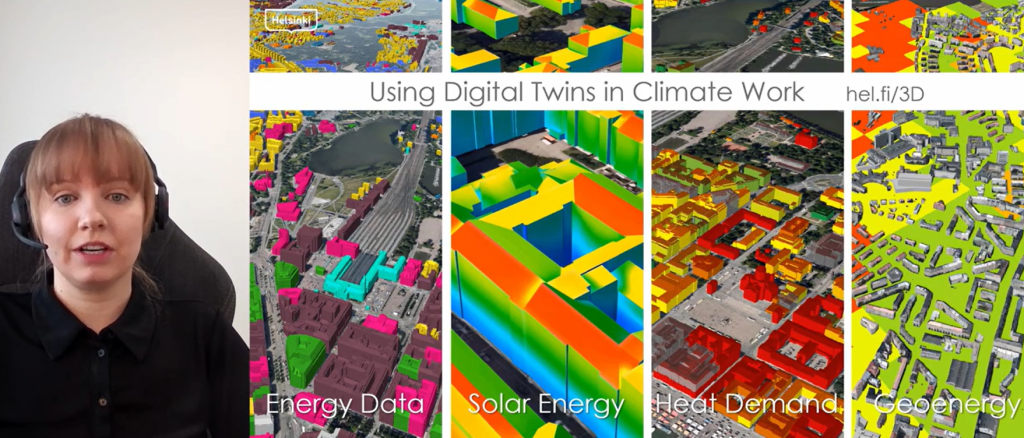
Enni Airaksinen of the City of Helsinki, Image courtesy of VTT Technical Research Centre of Finland / 2026 Finland–Sweden Smart Cities Forum
In Malmö, centralised data platforms allow the city to integrate information from across urban systems, including real-time water level monitoring, enabling faster and more informed responses to climate risk. In Finland, tools like Kausal’s climate planning platform help cities move from climate plans to measurable action tracking not just intentions, but outcomes.
On the energy side, the forum heard from Jonas Birgersson of ViaEuropa about a concept he calls the “internetification” of energy distribution, a decentralised model in which energy routers and local microgrids allow buildings and neighbourhoods to share renewable energy with each other, bypassing legacy grid bottlenecks. Umeå Energi in Sweden is already demonstrating how a forward-thinking energy utility can support industrial symbiosis, sharing heat and resources between facilities in ways that benefit both the climate and the local economy.
The panellists were unanimous: the tools are there. What is needed now is the organisational willingness to move from pilots to portfolios, from fragmented projects to system-level strategies.
Nature is Not a Nice-to-Have
One of the forum’s most thought-provoking contributions came from Miimu Airaksinen of Metropolia University, who made a compelling case that biodiversity must sit at the centre of smart city strategy, not on its periphery.
The economic case is stronger than many city leaders realise. Studies show that proximity to green and blue urban spaces can increase property values by 14 to 20 percent. Nature-rich environments reduce mental health costs, support children’s immune development and physical activity, and provide superior resilience against flooding and extreme weather events compared to engineered alternatives. Biodiverse ecosystems also function as carbon sinks making nature-based solutions a genuine tool for climate mitigation, not just adaptation.
There is also a supply chain dimension that often goes unnoticed. Around 70 to 90 percent of a building’s biodiversity impact occurs not during its use, but during the production of its materials and the generation of the energy used to build it. This means that procurement decisions the materials cities specify and the supply chains they support have an outsized effect on biodiversity outcomes. Circular economy approaches, including the reuse of materials and the development of new low-impact alternatives, are therefore essential elements of any serious urban biodiversity strategy.
As Airaksinen reminded the forum, quoting Churchill: we shape our cities, and then our cities shape us. The kind of cities we build determines the kind of future we inhabit.
Citizens as Co-Creators
A recurring theme throughout the forum was the central role of citizens in the smart city transition, not as passive beneficiaries of technology, but as active participants in designing the urban environments they live in.
Maarit Kahila of Mapita presented the Maptionnaire platform, which allows residents to share spatial knowledge about their neighbourhoods, identifying where they feel unsafe, where they value green space, and how they experience the urban environment in ways that can directly inform planning decisions. This kind of participatory data is qualitatively different from sensor data: it captures meaning, not just measurement.
The panel discussions reinforced this point. Sofie Sandin Lompar of Lund University highlighted “local transition arenas” ,structured processes that bring together diverse stakeholders to co-design climate responses at the neighbourhood level. Mari Hukkalainen described citizen co-creation initiatives in Finnish cities, where residents are involved in designing urban spaces from the outset rather than being consulted after the fact.
The message was consistent: technology can optimise a city, but only people can transform one. Engagement is not a communications strategy. It is an infrastructure as essential to the smart city as any digital platform.
Well known lessons as takeaways for city leaders
The 2026 Finland–Sweden Smart Cities Forum offered no shortage of inspiring examples, innovative tools, and bold ideas. But for city leaders looking to act, the core messages can be distilled into a handful of practical imperatives:
Own your data. Digital sovereignty is not a technical preference but a governance necessity. Cities that cede control of their data infrastructure to external vendors lose the ability to understand and steer their own transition.
Break the silos. Climate neutrality cannot be achieved department by department. It requires a cross-sectoral view of urban systems and the institutional structures to manage them as an interconnected whole.
Move from pilots to portfolios. Excellent technologies exist and are being demonstrated in cities across Finland and Sweden. The challenge now is scaling, building the shared standards, governance frameworks, and financial instruments that allow successful pilots to become city-wide solutions.
Set ambitious targets. High ambition is not a constraint. It is a signal that attracts the partners, the investment, and the talent needed to deliver. Cities that lead on climate become magnets for innovation.
Invest in people, not just platforms. Citizen engagement is not a box to tick. It is the foundation on which durable urban transformation is built. The cities making the fastest progress are those treating their residents as the most important resource in the transition.
The forum made one thing clear above all: the question is no longer whether cities can lead on climate. They already are. The question is how quickly the rest can follow.
Watch the recordings – All the presentations from the forum can be watched by registering at https://www.vttresearch.com/en/knowledge-base/2026-finland-sweden-smart-cities-forum-solutions-contributing-climate-neutrality