The City as a Living Laboratory: What Britain Is Learning About the Brain and Urban Life
Main newsScience and the citySmart Cities
by Sofija Tesic, BSc Psychology & Cognitive Neuroscience, University of Nottingham
Science & the City – A Mayors of Europe series exploring what science can teach us about the way we design and experience cities.
We usually measure whether a city works by looking at what moves through it: people, vehicles, goods, energy and information. We count journeys, measure congestion, monitor pollution and calculate how efficiently infrastructure performs.
But what if cities also measured something more difficult to see?
What happens inside the people moving through them?
Across Britain, researchers are beginning to approach urban life from this perspective. They are studying how people with dementia experience public transport, how visual environments affect walking, how the body responds to urban stress and how knowledge about the brain might eventually influence architecture and design.
These projects do not mean Britain is building “neurocities”. The evidence is nowhere near strong enough for such a claim. What is emerging instead is something more useful: new ways of studying how people experience the places designed for them.
Scientists are now able to ask questions about urban life that would have been far harder to investigate a few decades ago. They can study how people respond while navigating streets, moving through transport systems or experiencing different kinds of environments, not only by asking how they feel, but by combining those accounts with measures of behaviour and brain activity.
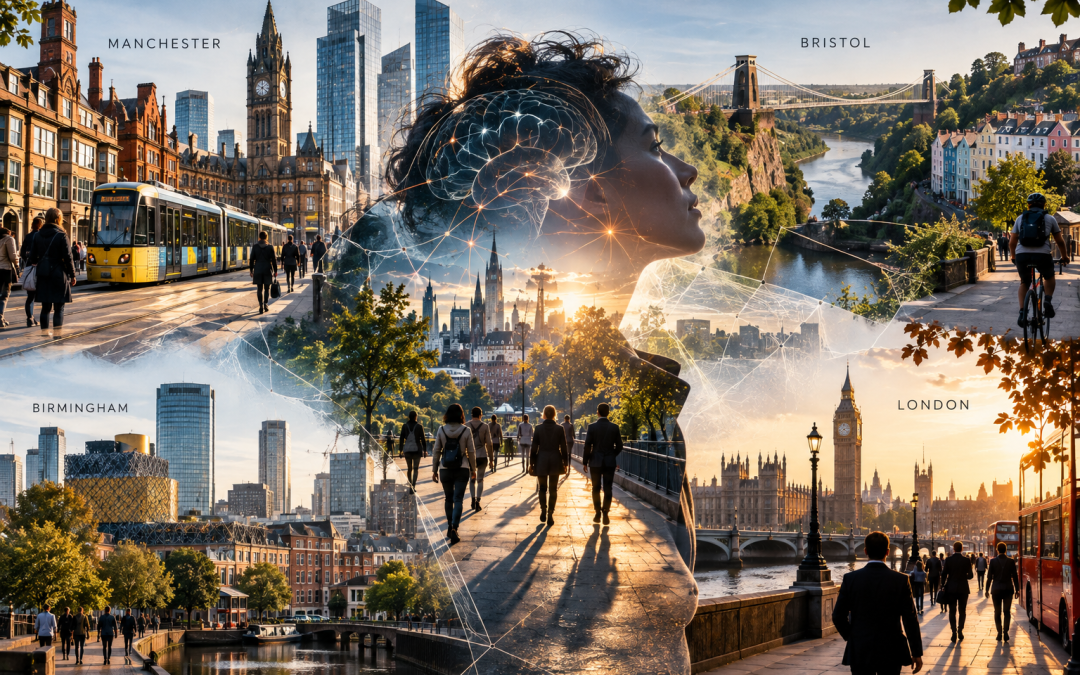
Manchester: When transport becomes a cognitive question
Public transport is normally evaluated through measures such as reliability, frequency, cost and passenger numbers. In Greater Manchester, researchers have asked a different question:
What is it like to use the transport network when memory and thinking are changing?
The University of Manchester’s Wellcome Trust-funded IN-CITU project, Interactions between Cognitive Impairment and Transport in Urban Environments, has studied how people living with dementia experience Greater Manchester’s public transport system. Rather than treating cognition as something happening only inside a person’s brain, the project examines how a person’s abilities interact with signs, buses, staff, other passengers, digital systems and the wider environment. (humanities.manchester.ac.uk)
Researchers accompanied passengers with dementia during real journeys, using interviews, photographs, mapping and observation to understand what made travel easier or more difficult. Recent publications from the project argue that dementia-friendly transport cannot be reduced to better signs or staff training alone. The wider organisation and design of the transport system also matter.
Traditional accessibility asks whether a person can physically use a service. Research like this asks whether the service also makes sense to them.
A ticketing system may be technologically efficient but difficult for someone experiencing memory problems. A journey that appears simple on a transport map may involve a series of decisions that become difficult when information is unclear or constantly changing.
Manchester therefore shows why designing for different minds may require researchers to study people while they are using the city, rather than assuming how they experience it.
Bristol: What does a street feel like?
Bristol brings a different dimension to the same question.
Researchers there have examined not only whether people walk through urban environments, but how the physical and visual characteristics of those environments influence the experience of walking.
At the University of Bristol’s Vision Institute, researchers have studied how the visual appearance of built environments affects people’s ability and willingness to move through them. Early work found that distracting floor patterns could influence walking routes and even affect the movement of the legs themselves. The research is being developed with an interest in creating environments that remain usable for an ageing population. (bristol.ac.uk)
Related research involving UWE Bristol has examined psychological experiences of walking through Bristol itself.
The significance is not that researchers have discovered the ideal street. They have not. It is that a street can now be studied as more than a route connecting two points. Its visual organisation, character and physical details may influence how people move through it and how they experience that movement.
That creates a different question for urban research:
Instead of asking only how many people use a street, should we also ask what the street feels like to use?
Birmingham: Measuring the response to the city
Birmingham pushes the question closer to neuroscience.
Researchers at the University of Birmingham have explicitly examined neurourbanism, an emerging approach that brings together research on cities, mental health, the body and the brain.
The terminology sounds more futuristic than the basic idea really is.
Traditionally, researchers might ask someone whether a particular environment feels stressful.
New portable technologies can add another layer. Researchers can collect physical measurements while people move through real environments rather than sitting in a laboratory.
In their paper From Urban Stress to Neurourbanism: How Should We Research City Well-Being?, Birmingham researchers reviewed the potential of these methods, including wearable sensors that allow physical responses to be linked to particular locations. (research.birmingham.ac.uk) But importantly, their argument is not that a sensor can tell planners whether a street is good or bad.
Physical measurements require interpretation. Someone’s response to an environment is influenced by their circumstances, experiences and social context. A measurement from the body cannot explain all of that by itself.
Birmingham therefore demonstrates both the promise and the danger of this field. Researchers can collect information about human experience that was previously difficult to measure outside laboratories. But more data does not automatically produce better urban policy. The difficult question is what level of evidence should be required before a scientific finding begins to influence planning decisions.
London: When neuroscience meets architecture
In London, that conversation is becoming more directly connected to design.
In 2024, University College London and the Research Institutes of Sweden launched the International Centre for NeuroArchitecture & NeuroDesign.
The collaboration brings together UCL’s Faculty of Brain Sciences and Bartlett Faculty of the Built Environment with researchers and designers from Sweden. Its aim is to investigate how built environments interact with cognition, behaviour and emotion, and how that knowledge might contribute to future architecture and design. (ucl.ac.uk)
Neuroscientists and architects have traditionally asked very different kinds of questions. One might investigate how humans recognise places or navigate space. The other must decide how an actual building, street or neighbourhood should work. The UCL initiative is an attempt to bring those conversations together.
That does not mean brain research is about to provide architects with a list of scientifically approved design rules. Instead, it raises the possibility that cognitive science could eventually become another source of evidence available during design, alongside engineering, environmental performance, accessibility, economics and the experiences of users themselves.
The challenge will be translating carefully controlled scientific findings into places that are far more complicated than any laboratory experiment.
From a neural formula to a better method
The British examples do not add up to a formula for the perfect city.
Manchester asks how transport changes when researchers begin with the experiences of people with cognitive impairment.
Bristol asks how the visual and physical character of a street influences the person moving through it.
Birmingham asks whether physical responses can provide another source of evidence about urban wellbeing.
London asks whether that evidence can eventually enter the architecture and design process itself.
Different questions, different methods and different institutions, but the same underlying shift. Cities have traditionally been very good at measuring infrastructure. They are beginning to develop better ways of measuring experience.
The future of this field should not be about designing cities according to a “neural formula”. Human life is far too complicated for that. Its value may instead lie in giving planners another type of evidence. Not simply whether a transport system moves enough passengers, but whether different people can understand and use it. Not simply whether a street carries pedestrians, but how its design affects the experience of walking through it. Not simply whether a building performs technically, but how the people inside it perceive, navigate and respond to it.
Britain is not yet building cities for the brain, but beginning to build the research methods that might allow us to understand the relationship between the two. And that may be the more important experiment.
REFERENCES
Pykett, J., Osborne, T., & Resch, B. (2020). From urban stress to neurourbanism: How should we research City Well-Being? Annals of the American Association of Geographers, 110(6), 1936–1951. https://doi.org/10.1080/24694452.2020.1736982
Bornioli, A., Parkhurst, G., & Morgan, P. L. (2019). Affective experiences of built environments and the promotion of urban walking. Transportation Research Part a Policy and Practice, 123, 200–215. https://doi.org/10.1016/j.tra.2018.12.006
Masoumzadeh, S., Yu, R., Bornkessel-Schlesewsky, I., Gu, N., Zhang, F., Cao, Z., & Sakhaei, H. (2025). Neuroscientific methodologies in urban studies: a systematic review and new directions for evidence-based urban design and planning. Cities & Health, 10(2), 455–475. https://doi.org/10.1080/23748834.2025.2493399
Ancora, L. A., Blanco-Mora, D. A., Alves, I., Bonifácio, A., Morgado, P., & Miranda, B. (2022). Cities and neuroscience research: A systematic literature review. Frontiers in Psychiatry, 13, 983352. https://doi.org/10.3389/fpsyt.2022.983352
Burtan, D., Joyce, K., Burn, J. F., Handy, T. C., Ho, S., & Leonards, U. (2021). The nature effect in motion: visual exposure to environmental scenes impacts cognitive load and human gait kinematics. Royal Society Open Science, 8(1), 201100.
https://doi.org/10.1098/rsos.201100Pykett, J., Osborne, T., & Resch, B. (2020). From urban stress to neurourbanism: How should we research City Well-Being? Annals of the American Association of Geographers, 110(6), 1936–1951. https://doi.org/10.1080/24694452.2020.1736982
Bornioli, A., Parkhurst, G., & Morgan, P. L. (2019). Affective experiences of built environments and the promotion of urban walking. Transportation Research Part a Policy and Practice, 123, 200–215. https://doi.org/10.1016/j.tra.2018.12.006
Masoumzadeh, S., Yu, R., Bornkessel-Schlesewsky, I., Gu, N., Zhang, F., Cao, Z., & Sakhaei, H. (2025). Neuroscientific methodologies in urban studies: a systematic review and new directions for evidence-based urban design and planning. Cities & Health, 10(2), 455–475. https://doi.org/10.1080/23748834.2025.2493399
Ancora, L. A., Blanco-Mora, D. A., Alves, I., Bonifácio, A., Morgado, P., & Miranda, B. (2022). Cities and neuroscience research: A systematic literature review. Frontiers in Psychiatry, 13, 983352. https://doi.org/10.3389/fpsyt.2022.983352
Burtan, D., Joyce, K., Burn, J. F., Handy, T. C., Ho, S., & Leonards, U. (2021).
The nature effect in motion: visual exposure to environmental scenes impacts cognitive load and human gait kinematics. Royal Society Open Science, 8(1), 201100. https://doi.org/10.1098/rsos.201100