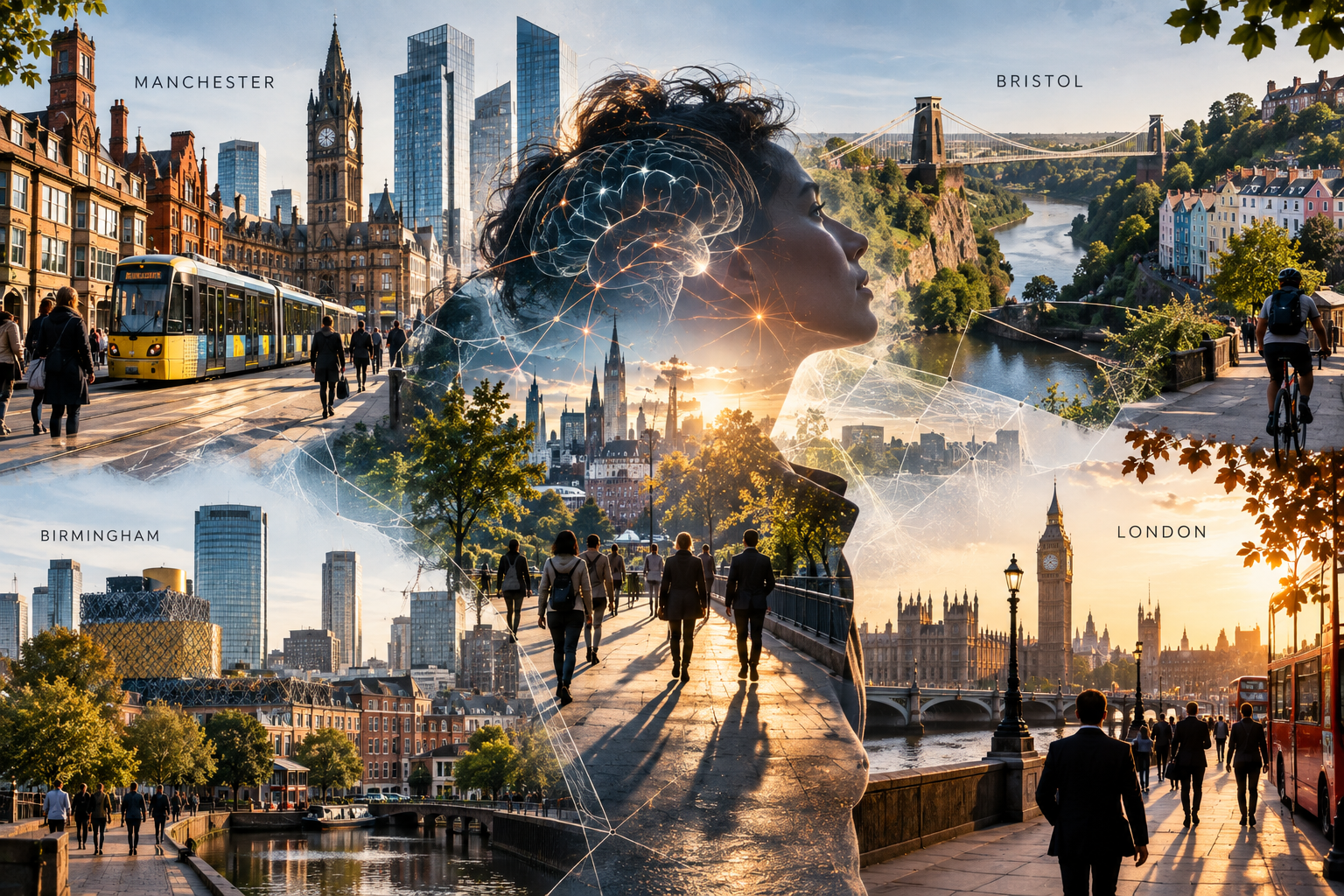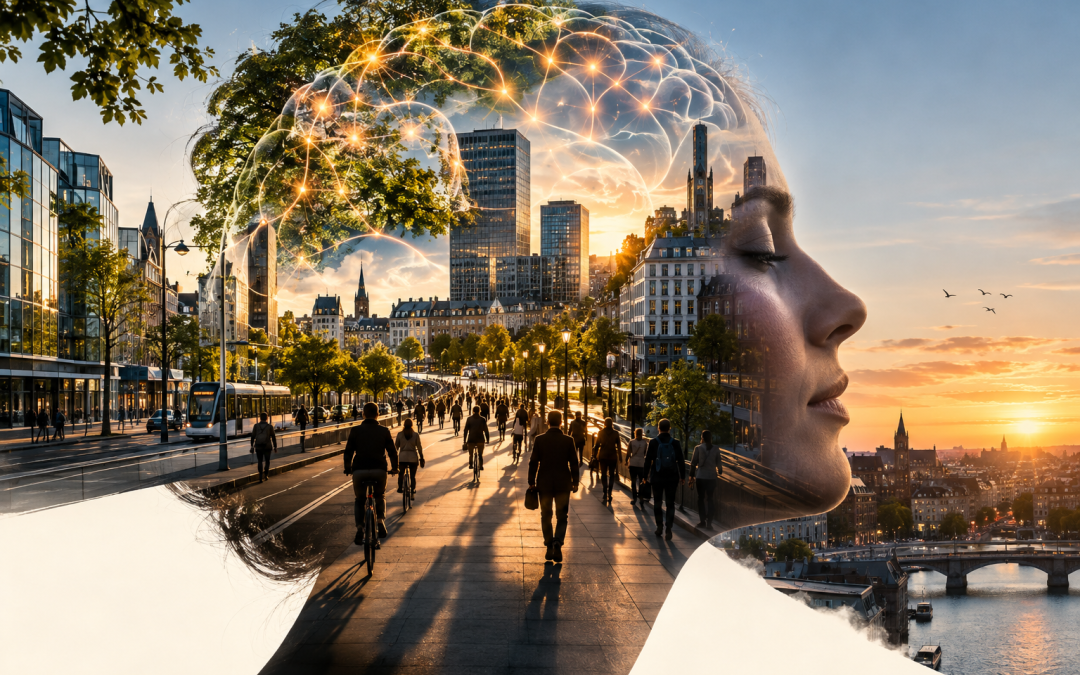
The Cities and The Brain: Can We Design Cities for the Human Brain?
Main newsScience and the citySmart Cities
by Sofija Tesic, BSc Psychology & Cognitive Neuroscience, University of Nottingham
Science & the City – A Mayors of Europe series exploring what science can teach us about the way we design and experience cities.
We spend most of our lives inside environments designed by other people.
The streets we walk through, the buildings we enter, the transport systems we use and the public spaces we share, all influence how we experience everyday life. The urban environment dictates our visual and auditory senses. They shape how much time we spend travelling, the amount of exposure we have to nature, how easily we can move through our surroundings and how much sensory information competes for our attention.
Urban planning has traditionally focused on questions of infrastructure, mobility, housing, economic development, sustainability and efficiency.
But there is another question that deserves more attention:
What happens when we begin to think about the city from the perspective of the human brain?
This does not mean that neuroscience can tell us how to design the perfect city. The science is nowhere near that point. It’s rather the emerging knowledge from neuroscience, psychology, public health and environmental sciences that tells us that our environments may influence our attention, stress, cognition, mood and wellbeing.
For city leaders, this raises an interesting possibility. Perhaps understanding how people respond to urban environments could become another source of evidence when we think about how cities should be designed.
The city as a cognitive environment
Cities are extraordinarily information-rich environments.
A single journey through a busy urban area may involve navigating traffic, reading signs, monitoring other pedestrians, processing sounds, deciding where to go next and filtering out advertisements, movement and visual distractions.
Yet the human brain does not have unlimited attentional capacity. We constantly select which information deserves attention and which can be ignored. Urban environments can place considerable demands on perception, attention and decision-making simply because of the amount of information they contain.
The more useful question is whether cities can provide stimulation without producing unnecessary cognitive strain.
Traditionally, an accessible environment is often understood in physical terms: whether someone can enter a building, cross a street or use public transport.
A city that is easy to move through physically may still be difficult to process cognitively.
The conceptualisation of the city as a cognitive environment therefore encourages us to consider not only what people are able to do, but also how much mental effort everyday urban life requires.
Stress and the urban experience
Urban environments are also closely connected to stress.
Again, it would be far too simple to argue that cities themselves are responsible for the stress. Urban life includes an enormous range of experiences, and cities can provide social opportunities, employment, healthcare, education, entertainment and much more.
At the same time, particular characteristics of urban environments may contribute to stress. Overcrowding, noise, long journeys, unpredictability, limited personal space, environmental pollution and a lack of control over one’s surroundings can all shape how people experience everyday life.
A more useful question is which aspects of urban environments are stressful, for whom, and under what circumstances.
Two environments with similar population density may be experienced very differently. One may feel energetic, socially connected and safe. Another may feel crowded, unpredictable and overwhelming.
What nature may offer
One of the fastest-growing areas of environmental research concerns access to natural environments.
Research suggests that exposure to natural environments may be associated with benefits for mood, stress and certain aspects of cognitive performance.
“Green space” is not one single exposure.
Seeing trees through a window is different from walking through a park. Spending ten minutes in a garden is different from living close to a large natural area. Exercising outside combines exposure to nature with physical activity, while simply having a park nearby does not mean that residents are able or willing to use it.
The important lesson for cities may therefore be less about the quantity of green space and more about the quality, accessibility and everyday presence of nature.
It may be worth considering how nature is integrated into the ordinary routes people take every day: the journey to work, the walk to school, the trip to a local shop or the time spent waiting for public transport.
The sensory city
A city is also a sensory environment.
We usually think about urban design visually: architecture, streets, skylines and public spaces. But people experience cities through sound, light, temperature, movement and smell as well.
Traffic, construction, public transport, commercial activity and crowds can create a continuous background of noise. Artificial lighting extends urban activity long after sunset. Screens, advertising and traffic signals compete for visual attention.
These features are often considered individually. From the perspective of the brain, however, they form part of the same broader sensory environment.
This creates a useful question for planners:
How much stimulation is necessary, and how much has simply become accepted as part of urban life?
The goal is not to make cities quiet, empty or visually uniform; cities are, by nature, dynamic places.
But a better understanding of sensory environments could help planners think more carefully about where intense stimulation is appropriate and where people may benefit from moments of relative calm.
Mobility is more than movement
The way people move through cities is normally discussed through practical measures. But movement through a city also has cognitive and emotional dimensions.
A journey can be predictable or uncertain, relaxing or frustrating, physically active or sedentary, social or isolating. Two journeys of the same length may therefore have very different psychological effects, while repeated daily journeys can shape a significant part of urban experience.
For many residents, commuting may occupy several hours each week. The design of stations, streets, crossings, cycle routes and waiting areas therefore forms part of the environment people repeatedly experience.
Thinking about mobility through the lens of cognitive wellbeing could encourage cities to ask different questions.
Not simply: How quickly can people move? But also: What is it like to make this journey every day?
Designing for human cognition
None of this suggests that urban planning should suddenly be based on brain scans. Cities are complex social systems.
Decisions about housing, transport and public space must balance many priorities, including affordability, accessibility, climate resilience, safety, economic activity and cultural identity.
Neuroscience is only one possible source of knowledge. But it may help broaden the questions that cities ask. Urban design could begin to consider cognitive wellbeing alongside physical wellbeing.
The aim is not to optimise cities for a single model of the brain, but to recognise cognitive and psychological wellbeing as one consideration among many in urban design.
What we still do not know
There are important reasons to remain cautious. Research examining the relationship between environments and the brain is still developing.
Some studies rely on relatively small samples. Others identify associations that cannot establish cause and effect. Researchers also use very different definitions of concepts such as stress, nature, urban exposure and cognitive performance.
Laboratory experiments create another challenge.
A person viewing photographs of a city while undergoing a brain scan is not having the same experience as someone walking through that city, meeting friends, commuting to work or living in the same neighbourhood for twenty years.
Individual differences matter too.
Children, older adults, people with disabilities, people with sensory sensitivities and people from different cultural backgrounds may experience the same urban environment in very different ways.
For neuroscience to become genuinely useful to urban policy, researchers will need more studies conducted in real environments, with more diverse participants and over longer periods of time.
Cities themselves could become important partners in that research. Instead of waiting for scientists to produce a universal formula for good urban design, city governments could work with researchers and communities to test how real interventions affect the people who use them.
From smart cities to human cities
For decades, cities have tried to become smarter. Technology helps monitor traffic, manage energy, analyse movement and improve public services. But perhaps the next stage of urban development requires a slightly different question.
Not only: How well is the city functioning? But: How are people functioning within it?
The answer will not come from neuroscience alone. And it should not.
Cities are shaped by politics, economics, culture, history and the choices of the people who live in them. But if urban environments influence how people think, feel, pay attention and respond to stress, then cognitive and psychological wellbeing deserve a place in conversations about the future of cities.
The most important contribution of neuroscience may therefore not be a set of design rules. It may simply be a new way of asking questions.
We have spent decades asking how to make cities smarter. Perhaps the next question is whether we can make them more compatible with the people who live in them.
REFERENCES
Lederbogen, F., Kirsch, P., Haddad, L., Streit, F., Tost, H., Schuch, P., Wüst, S., Pruessner, J. C., Rietschel, M., Deuschle, M., & Meyer-Lindenberg, A. (2011). City living and urban upbringing affect neural social stress processing in humans. Nature, 474(7352), 498–501. https://doi.org/10.1038/nature10190
Ancora, L. A., Blanco-Mora, D. A., Alves, I., Bonifácio, A., Morgado, P., & Miranda, B. (2022). Cities and neuroscience research: A systematic literature review. Frontiers in Psychiatry, 13, 983352. https://doi.org/10.3389/fpsyt.2022.983352
Liu, S., Ho, H. C., & Wilson, J. P. (2025). Effects of urban green space on human cognition: A systematic search and scoping review. Urban Climate, 60, 102372. https://doi.org/10.1016/j.uclim.2025.102372
Bell, C. N., St George, R., Honan, C., Bell, L. J., Jolly, A. T., & Matthews, A. (2025). The relationship between nature exposures and attention restoration, as moderated by exposure duration: A systematic review and meta-analysis. Journal of Environmental Psychology, 104, 102632. https://doi.org/10.1016/j.jenvp.2025.102632
Ohly, H., White, M. P., Wheeler, B. W., Bethel, A., Ukoumunne, O. C., Nikolaou, V., & Garside, R. (2016). Attention Restoration Theory: A systematic review of the attention restoration potential of exposure to natural environments. Journal of Toxicology and Environmental Health Part B, 19(7), 305–343. https://doi.org/10.1080/10937404.2016.1196155
Stevenson, M. P., Schilhab, T., & Bentsen, P. (2018). Attention Restoration Theory II: a systematic review to clarify attention processes affected by exposure to natural environments. Journal of Toxicology and Environmental Health Part B, 21(4), 227–268. https://doi.org/10.1080/10937404.2018.1505571
Bratman, G. N., Hamilton, J. P., Hahn, K. S., Daily, G. C., & Gross, J. J. (2015). Nature experience reduces rumination and subgenual prefrontal cortex activation. Proceedings of the National Academy of Sciences, 112(28), 8567–8572. https://doi.org/10.1073/pnas.1510459112
Thompson, R., Smith, R. B., Karim, Y. B., Shen, C., Drummond, K., Teng, C., & Toledano, M. B. (2021). Noise pollution and human cognition: An updated systematic review and meta-analysis of recent evidence. Environment International, 158, 106905. https://doi.org/10.1016/j.envint.2021.106905
Liu, J., Ettema, D., & Helbich, M. (2022). Systematic review of the association between commuting, subjective wellbeing and mental health. Travel Behaviour and Society, 28, 59–74. https://doi.org/10.1016/j.tbs.2022.02.006
Kretzschmar, J., Rath, N., Starke, K. R., Seidler, A., & Freiberg, A. (2026). The effect of exposure to artificial light at night (ALAN) on sleep disturbance: a systematic review and meta-analysis. Environmental Research, 292, 123689. https://doi.org/10.1016/j.envres.2026.123689
https://www.nature.com/articles/nature10190