
- en
The roads in English Leicester have been found to be the safest in Europe
Analyzing the transport sector in the context of sustainable development reveals the compromises between its advantages, and its negative impacts, such as oil dependency, environmental pressures, or road accident fatalities. Road accident fatalities have continuously fallen and have been reduced by more than half since 2000. This reduction in fatalities, especially in the short term, is in line with the 2020 target to halve the number of road mortality in Europe set by the European Commission.
Fatalities have reduced by 34.5 % since 2008 and have been cut by more than half since 2000. The main reason for this favorable trend is the EU road safety program.
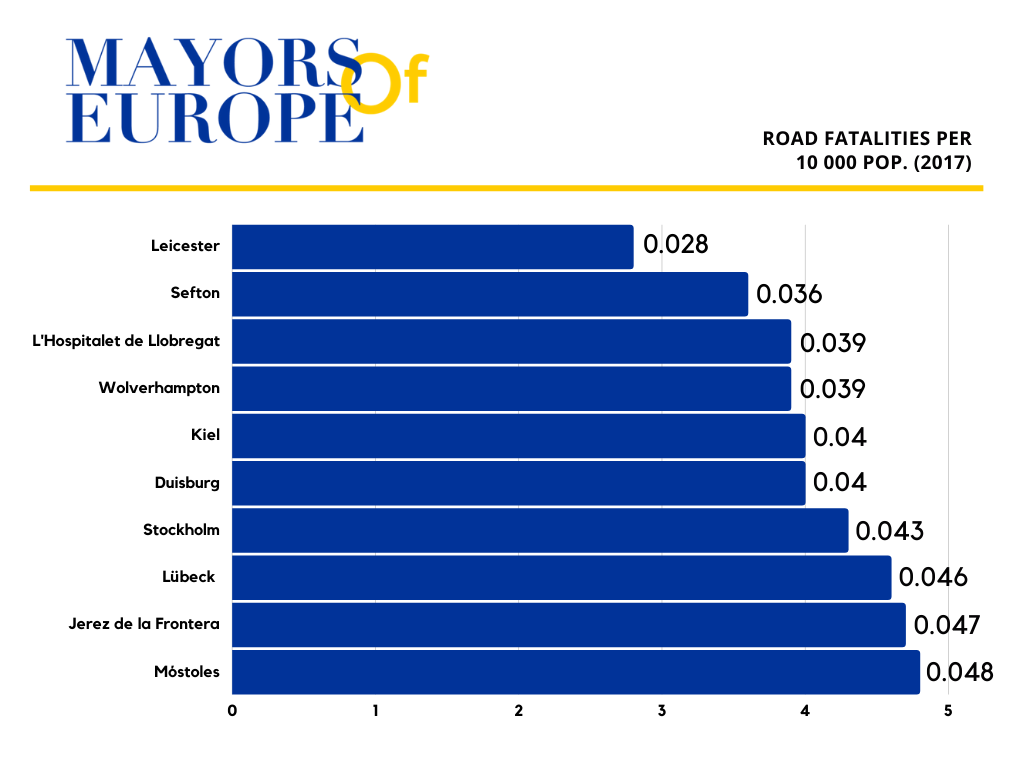
According to the latest complete Eurostat survey on sustainable transportation published in 2017, the segment of road safety regarding the mortality in road accidents (per 10 000 pop) took into consideration 668 cities from 20 EU countries. The safest roads, according to Top 10 cities, have United Kingdom (with 3 cities), Spain (3 cities), Germany (3 cities), and Sweden (one city).
The roads in English Leicester (United Kingdom) have been found to be the safest with 0,028 fatal outcomes in road accidents (per 10 000 pop). Another English city Sefton, a part of local government districts of the Liverpool City Region, takes second best place on the leaderboard with 0,036. L’Hospitalet de Llobregat, a municipality located southwest of Barcelona, is also respectable concerning road safety with 0,039 road fatalities. The equal level of safety with the same 0,039 road fatalities placed Wolverhampton, the city in central England, in fourth place.
Very close to the top with 0,04 in the ranking are two German cities: Kiel as the fifth and Duisburg as sixth.
The only capital among the Top 10 took seventh place – Swedish Stockholm with 0,043.
With just point zero zero one of decimal difference lined up Lübeck (Germany) as the eight with 0,046, the ninth Jerez de la Frontera (Spain) with 0,047, and as the tenth Spanish Móstoles.
The best not by the accident
The good practice and efficient measures introduced in Leicester achieved less than three (0,028 ) road fatalities per 100 000 inhabitants and putting this English city on the top of the 668 cities in the survey.
Leicester record accident data to help identify accident locations and work towards reducing road casualties. Leicestershire County Council is committed to collecting traffic data and provides Road Traffic Collision data for all roads within Leicestershire.
Leicestershire County Council has a long history of survey work. The team of staff including 24 full-time traffic enumerators is proud of its reputation for the provision of excellent service and high-quality data. The Data Collection Team can provide data on all types of traffic and pedestrian movements from over 262 Automatic Traffic Count sites.
Data can be collected by real-time observation or captured using cameras and analyzed later. Videos can also be used to capture vehicular interaction at busy and congested junctions, pedestrian movements, and bus passengers.
The required output for each survey is different, so the expert knowledge of the Data Collection Team is vital in the assessment of each requirement to ensure the analysis and provision of relevant and accurate data.
Leicester also runs a number of campaigns throughout the year to promote safer driving:
Safer driving with age sessions
The residents of age 60 or over who want to feel more confident on the road can apply for safer driving with age session.
Using their own car, each session lasts an hour around local roads and with an approved instructor. This is not a driving test, but if the participant’s driving is not up to the standard, the necessary guidance and advice will be provided.
Driver Education Workshops, launched in October 2004, runs five courses
– Speed Awareness
– Driver Alertness
– Driving 4 Change
– What’s Driving Us
– National Motorway Awareness
Pre-driver courses
Leicester offers Pre-driver courses for people aged 16/17 who are interested in learning to drive. The course aims to raise awareness of the challenges faced by young, inexperienced drivers giving them the knowledge and understanding to make safe choices as drivers and passengers.
The course is a mixture of classroom and practical sessions, including:
– An introduction to driving
– Issues relating to speed
– A practical session accompanied by a qualified driving instructor in a dual-control car
Sustainable development
Fatalities due to road accidents are an important indicator of road safety. It includes drivers and passengers of motorized vehicles as well as pedestrians. A road accident victim is considered as a road fatality if he or she is deceased within 30 days from the day of the accident.
The majority of Member States still have to further strengthen their efforts to meet the EU’s goal of halving road fatalities at the national level. Between 2000 and 2013, the highest relative reduction of road fatalities was observed in Latvia. In this period, only Malta reported an increase, although on a very low absolute level. The safest Member States, United Kingdom, Denmark, and Sweden, have reached three or less than three road fatalities per 100 000 inhabitants by 2012.
Recent key initiatives include a new EU Driving Licence delaying the access of young people to powerful motorbikes, exchanges of best practices concerning enforcement plans, and cross border enforcement rules.
The European Road Safety Action Program provides a general governance framework to guide national or local strategies. At the EU and national level seven objectives have been set:
- Improve education and training of road users
- Increase enforcement of road rules
- Safer road infrastructure
- Safer vehicles
- Promote the use of modern technology to increase road safety
- Improve emergency and post-injuries services
- Protect vulnerable road users.
photo: Wheatley Hill / CC BY-SA 4.0