It’s Just a Bench, Until It Generates Energy, Data, and Public Value
Most of the digitalization efforts shaping our cities today remain, for many citizens, abstract.
We download apps.
We unlock bikes and scooters.
We pay for transport, track air quality, receive notifications.
The city becomes more intelligent, but often through a screen.
Yet the experience of the city itself, the benches we sit on, the parks we pass through, the spaces where we pause, remains largely unchanged.
And this is where a quiet disconnect begins to emerge.
Because while cities are becoming increasingly data-driven, the infrastructure people actually use every day is rarely part of that transformation.
What if intelligence did not sit behind an interface, but was embedded directly into the physical fabric of the city?
credit:Strawberry energy
At first glance, it is a simple intervention: a bench.
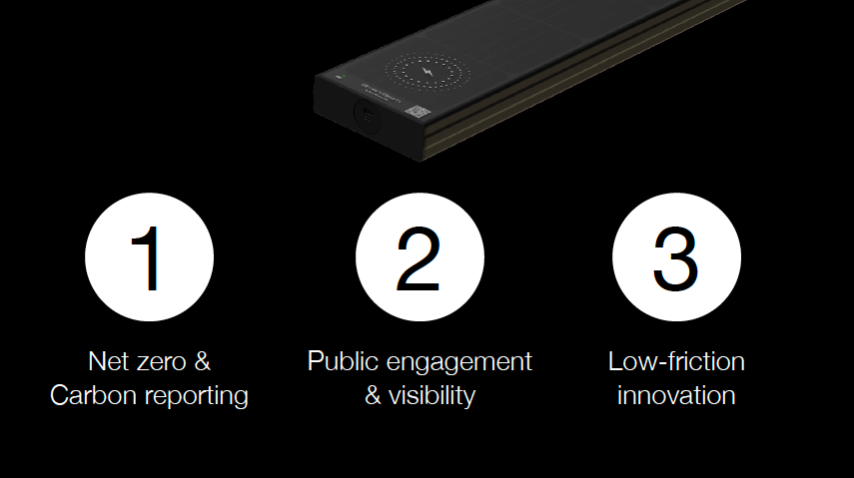
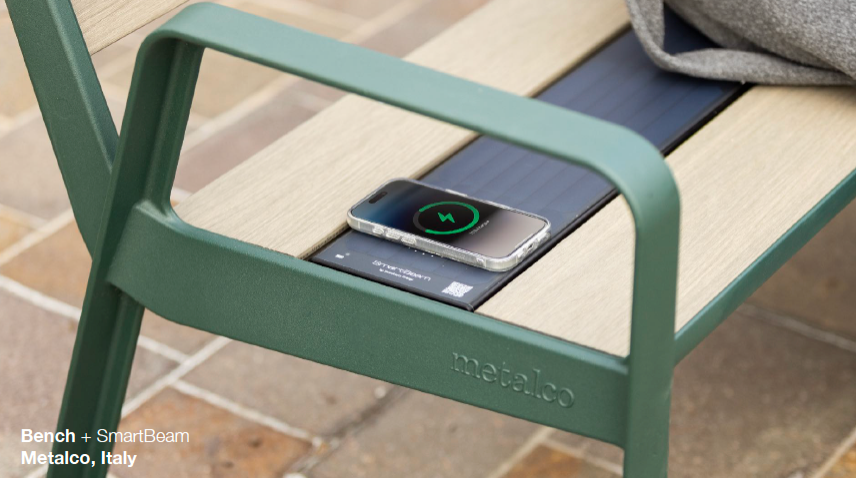
But as the SmartBeam concept illustrates, it functions as something far more consequential, a small-scale, distributed layer of urban infrastructure embedded directly into public space.
Powered entirely by solar energy, each unit combines everyday utility with digital capability: enabling device charging, providing lighting, and integrating sensors that capture environmental conditions and usage patterns in real time.
What makes this model relevant for cities is not the technology itself, but how seamlessly it integrates into daily life. There is no need for new systems to be learned, no behavior to be forced.
People sit. They charge their phones. They pause. And in doing so, they become part of a living system that generates energy, captures data, reflects patterns of use in public space.

credit: Strawberry energy
Why It Matters for Cities
For city administrations, this introduces a different way of thinking about infrastructure.
Rather than investing solely in large, centralized systems, cities can begin to build intelligence at the edge, through small, visible, and immediately useful interventions.
The advantages are practical:
- Low-friction deployment
Existing street furniture can be retrofitted, avoiding complex infrastructure changes. - Immediate public value
Citizens engage with the infrastructure from the first day - Scalability across city contexts
Suitable for parks, transit areas, public squares, and mid-sized urban environments alike
This is particularly relevant at a moment when many cities are seeking ways to move beyond pilots and demonstrate tangible progress.
credit: Strawberry energy
From ESG Reporting to Public Experience
Perhaps the most important contribution, however, sits within the ESG dimension.
Cities are under increasing pressure to report on:
- carbon reduction, energy efficiency, environmental impact
yet, these efforts are often experienced only through reports and targets. What this approach changes is the visibility of impact.
Each unit tracks energy production and CO₂ savings in real time, making sustainability measurable not only for city administrations, but visible to citizens themselves.

credit: Strawberry energy
To understand what it takes to move from concept to deployment, and how such solutions can align with real city needs, we spoke with Miloš Milisavljević, CEO of Strawberry Energy, the company behind the SmartBench and SmartBeam solutions designed to enhance urban spaces while generating energy, collecting data, and contributing to cities’ sustainability goals.
Your infrastructure generates real-time data at street level. How do cities actually use this data and where do you see its role evolving in broader urban decision-making?
It really depends on the city. In some of the best cases we saw cities use SmartBeam’s real-time, street-level data to understand how public spaces are actually used, not just how they were designed to be used. For example, a city can see that a square is busiest between 5–8pm rather than during the day, or that certain areas are underused despite heavy investment.
In practical terms, this helps cities adjust cleaning schedules, improve lighting where people actually gather, or plan events at times when spaces are naturally active. For instance, if data shows people tend to sit longer in a particular park corner, the city can prioritise adding shade, greenery, or additional seating there.
Looking ahead, this type of data will move cities from periodic planning to continuous decision-making. Instead of making changes once every few years, municipalities can respond dynamically, similar to how traffic systems already adapt in real time. Over time, we hope this becomes a core layer for urban management, helping cities allocate resources where they have the most impact.
It’s ‘just’ a bench, yet it delivers energy, data, and public value. How do citizens actually experience that in their daily routines?
In practice, most people will never think about smart city technology. But they will notice that the bench they sit on every evening now charges their phone. They’ll feel safer walking through a park because it’s better lit. They’ll spend an extra few minutes in a public square because it’s simply more comfortable.
Take a typical situation: someone on their way home notices their battery is about to die. Instead of worrying, they sit down for a few minutes, charge their phone, and continue their journey. Or someone walking through a park in the evening naturally gravitates towards a bench that is lit and feels safe, without needing to think about it. These small moments add up. Waiting for a bus becomes more comfortable, a short break becomes more useful, and public spaces feel more reliable and welcoming.
There is also a more visible sustainability layer. A solar-powered bench can display in real time how much energy it has generated and how much CO₂ has been saved right where people are sitting. Sustainability stops being a distant policy goal and becomes something immediate, tangible, and part of everyday life.
The citizen doesn’t see the system. They just feel the difference.
Your solution can retrofit existing infrastructure. What does this unlock for cities in practical terms?
Retrofitting is a game-changer because it eliminates the need for expensive and disruptive civil works. Retrofitting allows cities to upgrade what they already have instead of replacing it. Cities can transform traditional, “old-school” furniture into smart, solar-powered hubs overnight without digging up pavements or laying new cables.
For example, instead of removing all benches in a city centre, a municipality can convert selected benches into smart ones adding charging, connectivity, and data capabilities within days rather than months. This drastically lowers the barrier to entry for smart city technology, allowing for faster scaling and immediate public impact at a fraction of the cost of new installations.
It also unlocks more balanced urban development. Rather than focusing only on flagship “smart districts,” cities can bring improvements to everyday locations: residential areas, smaller parks, or suburban centres. At the same time, it supports sustainability by extending the life of existing infrastructure instead of replacing it.
In short, retrofitting turns existing assets into a network of smart, useful touchpoints across the city. Quickly, affordably, and with minimal disruption.