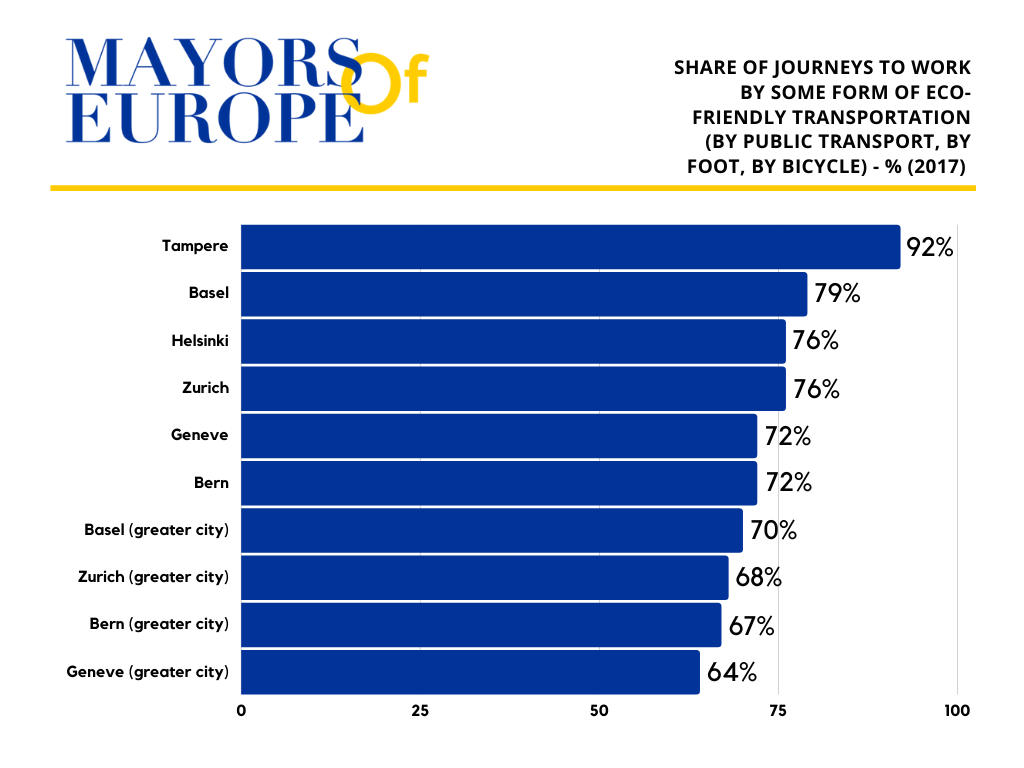
Finnish Tampere tops with 92% of citizens using environmentally friendly transport, but as many as 8 places goes to Swiss cities and metropolitan areas
The latest complete Eurostat survey on sustainable transportation published in 2017 has already shown a significant CO2 emissions drop of 14 % on average in 2014 compared with 2009. The fall in this short-term period was largely the result of EU Regulations.
Support for public transport and cycling in daily mobility many European cities consider to be an effective policy to reduce air pollution, traffic jams, and carbon dioxide emissions
The leading European cities, according to Eurostat survey for travel to work by some form of ecological transport (public transport, on foot, by bicycle) three years ago, introduced successful solutions and path the way for eco-friendly transportation.
Finnish Tampere (Tammefors) leads among the surveyed cities with 92% citizens using eco-friendly transportation to travel to and from work. In Basel (Switzerland) this green percentage is only slightly lower – 79% of eco-friendly travel, while in Helsinki (Helsimgfors) citizens who travel to and from work on foot, bicycle, scooter or public transport is 76%, just as do residents of Zurich (Switzerland).
All the remaining six positions in the Top 10, belong to Swiss cities and urban settlements. The fifth and sixth places in the ranking are shared by Geneva and Bern with 72%, the seventh is Basel (wider area) with 70%. In Zurich (wider area) 68 % of residents are using the carbon-neutral way of transportation.
Bern (the wider area) has a 67% share of more environmentally friendly commuting, and Geneva (the wider city area) has a 64% share of going to work on foot, by bicycle and by public transport instead of cars.
Reducing the harmful effects of transport is an important EU policy goal. Air pollutants, atmospheric particulate matter, and nitrogen dioxide, in particular, endanger human health and damage the environment. Although air pollution from transport has decreased over the past decade thanks to the introduction of fuel quality standards and emission standards, and the use of cleaner technologies, air pollutant concentrations are still too high.
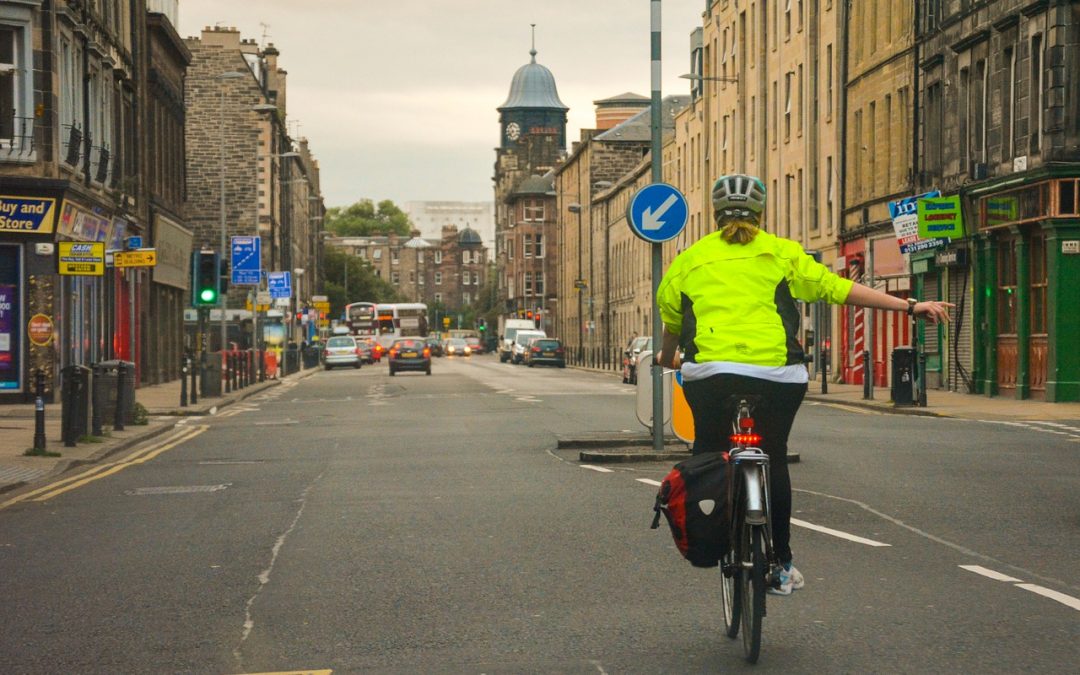
Planning and transport experts encourage various sustainable transport alternatives, such as using public transport, walking, and cycling as affordable transport options to counteract the negative effects of car use for all.
Air pollution in the Covid-19 era
Most countries reacted to the pandemic with physical distancing to slow transmission. Lockdowns reduced economic activity and road traffic, in some places by almost 85%.
A number of cities have introduced pandemic-safe transport measures to lower risk for commuters. This typically includes temporary extra space, priority, and infrastructure for walking and cycling as well as lower speed limits and other restrictions for drivers. The goal is to allow pedestrians and cyclists to stay at a safe distance without increasing the risk of road accidents. The public is now walking, cycling, and driving more, while the use of public transport has dropped.
The Covid-19 pandemic and lockdown have had a profound impact on mobility and air pollution in Europe. Transport and Environment (T&E) and the European Public Health Alliance (EPHA) decided to gauge public opinion on air pollution and mobility choices as lockdown measures ease and cities confront a commuter challenge. International research data and analytics company YouGov2 polled 7,545 adults of varied age, income, and gender backgrounds living in 21 of the biggest cities across six countries between 14 and 21 May 2020.
Chosen cities in the analysis had the most significant air pollution and mobility change. The survey shows that an overwhelming majority of European city residents want their mayors and local governments to take effective measures against road traffic air pollution. The main findings are:
- Roughly two in three people (64%) surveyed do not want to go back to pre-pandemic pollution levels as they experienced good clean air.
- Three quarters (74%) demand protection from air pollution, even if it means reallocating public space.
- Two in three (68%) demand protection from air pollution, even if it means preventing polluting cars from entering city centers.
- One in five (21%) plans to cycle more; one in three (35%) to walk more after lockdown.
- Among people who used public transport before the lockdown, 54% will return to use this mode if sufficient hygiene measures are taken. 27% will return regardless of the risk of contagion.