Participation as Infrastructure: How Go Vocal Is Strengthening the Next Generation of Cities
Wietse Van Ransbeeck is the co-founder and CEO of GO VOCAL, formerly known as CitizenLab, a civic tech platform designed to help governments engage their communities more effectively. Since launching in 2015, Go Vocal has supported over 600 local governments across more than twenty countries in shaping more participatory, transparent policymaking, including cities such as Oslo, Copenhagen, Vienna, Dublin, Seattle, St. Louis, and Kansas City. Wietse has been at the forefront of reimagining how democratic participation can evolve through technology with inclusion, trust, and accountability at its core, and his work at this intersection of democracy and technology has earned him a place in the Obama Foundation Leaders Europe 2025–2026. program.
You started this journey over a decade ago, driven by the aim of improving your city but not having the tools to engage effectively. What inspired you to turn that early experience into a civic tech platform, and how has your mission evolved since the early days of CitizenLab?
When we started back in 2015, it was out of a very personal frustration: my co‑founder Aline and I wanted to improve our neighbourhood, but we couldn’t find an easy way to share our ideas beyond attending a council meeting on Tuesday evening. We felt there had to be more to democracy than printing out forms, queuing at town hall, or squeezing into a council meeting after work.
We felt there had to be more to democracy than these slow, bureaucratic channels – people were clearly looking for easier, more accessible ways to participate in the decisions shaping their everyday lives.
CitizenLab was born from that gap: we wanted to build a simple digital bridge between residents with ideas and the people in city hall who could act on them. In the early days, our mission was quite straightforward: make it easier for local governments to collect ideas and feedback from their communities.
Over time, as our work spanned hundreds of governments in more than 20 countries, that mission evolved. Today, as Go Vocal, our focus is not just on gathering input but on helping governments build a culture of participation in which listening to residents is embedded in everyday decision‑making rather than treated as a one‑off project. We’ve shifted from “let’s run a consultation” to “how do we make decision‑making more inclusive, participatory, and responsive by default?”
What hasn’t changed is the core belief: democracy works better when more people can shape the decisions that affect their daily lives

Your recent shift from the name “CitizenLab” to “Go Vocal” reflects a broader and more inclusive vision. What prompted this change, and how does it signal a new approach to building public trust in local democracy?
Changing our name from CitizenLab to Go Vocal was not a cosmetic exercise; it reflected how much we’ve grown and how much the space has changed. CitizenLab started as a “lab” to test new forms of participation. Today, we’re building something bigger: a piece of critical infrastructure for local democracy that helps communities speak up and helps institutions truly listen.
“Go Vocal” expresses that more clearly. It is an invitation, to residents, to civil servants, to elected officials, to make their voices heard and to put listening at the heart of governance. It also reflects a broader, more inclusive vision: we don’t just want to serve the already engaged; we want to help governments reach those who rarely feel democracy is for them.
The rebrand also signals a shift from a single tool to a comprehensive participation hub. We’re investing heavily in capabilities like AI‑powered sensemaking and smarter workflows, so that engagement isn’t an isolated activity but part of how a city understands, prioritises, and responds to its community. In that sense, GoVocal is our commitment to rebuild trust in democracy from the ground up – voice by voice, decision by decision.
Many communities struggle to include voices beyond the “usual suspects.” How does Go Vocal engage residents who are traditionally underrepresented, and what strategies have proven most effective in reaching them?
One of the biggest challenges in citizen engagement is hearing from the same people over and over again. If we only listen to the “usual suspects,” we risk reinforcing existing inequalities rather than reducing them. From day one, we’ve been asking: how do we design a platform that enables governments to include those who are too busy, too sceptical, or too marginalised to show up?
Our approach is really about using technology to create more space for human connection, not less.
That starts with lowering the barrier to participate: a mobile‑first platform, multilingual interfaces, and formats that let people contribute in just a few minutes from their phone.
At the same time, we deliberately build tools that help stitch together online and offline input. Public servants can digitise handwritten notes from post-its during in-person workshops at neighbourhood centres or street conversations, transcribe interview recordings with speech‑to‑text, and bring all of that into the same workspace as the online responses.
On the back end, smarter workflows, robust reporting, and AI‑driven analysis help public servants quickly understand who is participating, what different groups are saying, and where the gaps are. Instead of spending hours or even days trying to pull data, they get structured insights for more targeted outreach to underrepresented groups.
Because the heavy lifting of capturing and processing input happens in the background, teams can spend more of their time where it really matters: out in neighbourhoods, meeting people where they are and having deeper conversations.
Finally, when you look at the topics that tend to mobilise people, very concrete, lived issues like public spaces, safety, mobility, or climate resilience, and you pair that with visible follow‑up on what was decided, you start to see engagement become much more diverse.
What does genuine civic listening look like to you? Beyond gathering input, how can local governments build a culture that truly listens, responds, and evolves based on what citizens say?
Genuine listening is more than opening a comment box or running a survey. For me, it has three components: openness, responsiveness, and learning.
First, openness: being clear about what is on the table, what isn’t, and inviting different types of knowledge – data, expertise, but also lived experience.
Second, responsiveness: closing the feedback loop by showing people how their input influenced the decision, and being honest when it didn’t.
Third, learning: using each engagement process to improve the next one, both in terms of methods and internal culture.
Local governments that “get it” don’t treat participation as a legal requirement or a communication exercise. They embed listening into their workflows: councillors get regular engagement insights, civil servants co‑design projects with residents, and teams are rewarded not only for delivering projects, but for how they involve the community.
In the end, this kind of genuine participation is what builds trust – and trust is the single most important currency a political leader has.
Culture changes when leaders model this behaviour and when staff have the tools and support to make it part of their everyday work.
Could you share a moment when Go Vocal helped a city make a better policy decision? What was the outcome, and what did it reveal about the potential of digital tools to shape responsive governance?
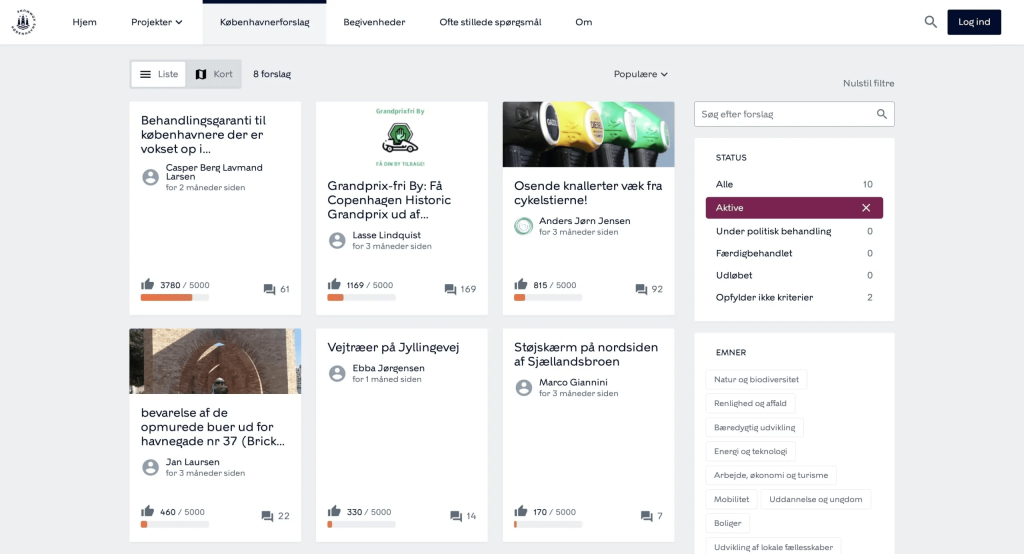
One example that I’m particularly proud of comes from Copenhagen. The city launched a Go Vocal platform for a bottom‑up proposals initiative. Any resident can submit an idea and if it reaches a clear support threshold, it will be put on the agenda of the council meeting.
In just four months, over 12,000 residents registered on the platform to submit, support, and debate ideas for improving life in the city.
Among those ideas was a powerful proposal to guarantee treatment for Copenhageners who grew up in abusive or harmful environments. The proposal attracted thousands of supporters and won unanimous backing from the Social Welfare Committee, securing its place on the political agenda and in budget discussions.
What makes this especially meaningful is that it exposed a blind spot in existing social policy: the long‑term mental health needs of children from abusive homes were not being addressed with the urgency and structure they deserve.
By giving people a simple way to elevate that lived experience into a concrete proposal, the platform helped turn an often invisible problem into a recognised policy gap – with a clear mandate for the city to act on it.
There’s growing concern that civic tech could unintentionally create new barriers or deepen distrust. What do you see as the limits or risks of digital participation tools, and how do you mitigate them?
I often say that digital democracy is not a silver bullet; it’s a lever. Used well, it can lower the cost of participation and bring in more diverse voices, but it also carries risks, yes. If we’re not careful, platforms can mainly attract already empowered groups, reinforce polarisation, or create a sense of “click‑tivism” where people are asked for their views but nothing changes.
Our philosophy at GoVocal is to see technology as an enabler for better representative democracy, not a replacement for it. That’s why we strongly encourage hybrid processes that combine online tools with offline outreach, and we work with cities on the “rules of the game”: being transparent about what is being decided, who decides, and how resident input will be used.
We also invest heavily in safeguards around inclusion and in explainable AI, so that when we summarise or cluster citizen input, we don’t erase minority voices or turn democracy into a black box.
Handling large volumes of citizen input brings ethical challenges. How does Go Vocal ensure responsible data use, especially when it comes to transparency, consent, and government accountability?
When thousands of people share their ideas, frustrations, and hopes on a platform, they are extending a huge amount of trust. We have a responsibility to treat that data not as a commodity, but as part of the democratic infrastructure of a city.
Concretely, this means privacy and consent by design, being very clear about why data is collected, how long it is stored, and who can access it – and strong compliance with data protection regulations.
It also means giving governments better tools to be transparent with their residents: publishing engagement summaries, sharing how input was interpreted, and documenting how it influenced the final decision.
Finally, as we use AI to help civil servants make sense of large volumes of input, we do so in a way that is auditable and explainable, because people should be able to understand not only that they were heard, but how their voice contributed to the overall picture.
One of the biggest hurdles cities face is turning input into impact. What are the key ingredients that help city leaders move from engagement to meaningful results?
In my experience, the biggest determinant of success is not the technology, but the mandate and culture around it. When we start working with a city, I often ask: is there political will to genuinely share power, even a little bit, or is this mainly about checking a box?
Where it works well – whether in St. Louis, Oslo, or Dublin – you usually see four ingredients. First, a clear political mandate and scope: leaders are explicit about what is up for discussion and what is not. Second, internal ownership: there is a dedicated team or champion inside the administration who connects engagement to real policy and budget cycles.
Third, integration: insights from engagement don’t sit in a PDF; they feed into strategies, plans, and council debates. And fourth, feedback loops: the city makes a habit of telling residents, “Here’s what you told us, here’s what we’re doing, and here’s why.”
In St. Louis, for example, this combination meant residents could see how their ideas on long‑term resilience translated into concrete investments, including the creation of a relief and recovery fund to support communities after major storms. That is where you start to rebuild trust: not just by asking questions, but by showing impact.
Building a Shared Civic Infrastructure – Go Vocal works with cities across continents. How do you see the future of international collaboration in civic participation?
One of the privileges of my job is seeing how cities on different continents wrestle with similar questions: how do we rebuild trust, deal with polarisation, and respond to crises together with residents rather than for them? The contexts differ, but the underlying challenges rhyme.
I believe we’re moving towards a shared civic infrastructure where good ideas and practices can travel faster. That could mean common principles for digital participation, on transparency, inclusion, and data ethics, that cities from Copenhagen to Kansas City commit to. It also means building stronger networks where practitioners share playbooks, not just success stories, but also what didn’t work.
Our role as Go Vocal is increasingly to connect these dots: when a city pioneers a new way of involving young people in climate policy, we can help translate and adapt that model for others, so that democratic innovation doesn’t stay siloed
If you were speaking to a mayor who is hesitant about digital participation, what would you say to encourage them to take the first step?
When I meet mayors who are sceptical about digital participation, I try to start from their reality. They are dealing with tight budgets, complex crises, and often a very polarised public sphere. Opening up can feel risky.
What I say is: the risk of not engaging is actually bigger. People will still have opinions; they will just express them on channels you don’t control, and you’ll miss out on constructive ideas that could help you govern better. Digital tools, used thoughtfully, can make participation more manageable and more representative by reaching beyond the usual voices.
My advice is to start with one concrete use case where you have both political will and room to act – like a neighbourhood plan, a mobility project, or a specific fund – and commit to closing the loop at the end. If residents see that you listened and can point to a tangible outcome, like in St. Louis with their storm relief and recovery investments, your next engagement will be easier, not harder.
Our job at Go Vocal is to make that first step as safe and as rewarding as possible – for you and for your community.