- en
Dublin’s transition towards green energy resources
The city of Dublin has long been a staunch supporter of combating the climate change. The city made its first significant steps back in 2007, when the City Council announced its support for the national White Paper “Towards a Sustainable Energy Future for Ireland 2007 – 2020“.
This agreement recognized the harmful effects of fossil fuel usage. Back then, this source of energy supply produced over half of all greenhouse gas emissions. The proposed strategy aimed at the redesign and transition towards green energy supply for transport, industry and housing sector.
In order to support this effort even further, the local administration also supported the nationwide “Strategy for Renewable Energy 2012 – 2020“. This plan proposed 20% improvement in energy efficiency by 2020. Alongside this measure, it introduced 20% reduction of greenhouse gas emission and 20% green energy supply for the whole country. This was further followed with Ireland’s Transition to a Low Carbon Energy Future 2015 – 2030”.
In order to achieve desired results set by these initiatives, the City Council of Dublin established its own policies, such as the Dublin Waste to Energy Project. This project focuses on promotion of renewable energy resources. It is a public-private partnership, which promotes innovative ideas for both green transition and establishment of circularity.
The main plan was the construction of a thermal treatment plant, near the Poolbeg neighborhood. After its construction, this plant used all municipal waste which could not be recycled or reused. These materials, about 600,000 tonnes annually, were used to generate electricity. The amount produced in this facility is sufficient to supply 80,000 households each year.
To further supplement this strategy, the City Council also introduced Dublin City Spatial Energy Demand Analysis, also known as SEDA. The primary purpose of this research was to determine the current and future energy demand. Besides this aspect, the analysis was done on local resource availability.
During this research, a special methodology presented by private company Codema was used. It allowed researchers to develop estimations about future energy demands of all buildings around the city. As a result of this research, the real energy data maps were presented for municipal, commercial and residential buildings. This analysis allowed the local government to determine technical solutions for incorporation of renewable energy supply and energy efficiency.
The latest one among these projects came in the sphere of electricity. Two most important companies, ESB Networks and Eirgrid, established close collaboration with the local government. ESB Networks is responsible for construction and maintenance of electricity infrastructure. On the other hand, EirGrid focuses on operation and development of transmission systems.
The partnership established between these two companies and the City Council resulted in the GRID25 strategy. This project aims at redevelopment of the existing network and adapting it to increased energy demand and green sources.
The strategy aimed at converting existing thermal generating stations at Poolbeg, North Wall, Huntstown and Irishtown to ones more suitable for the use of green energy. It also introduced wider use of wind resources. The facilities and infrastructure of this resource would be stationed near the coast, while turbines would be placed offshore.
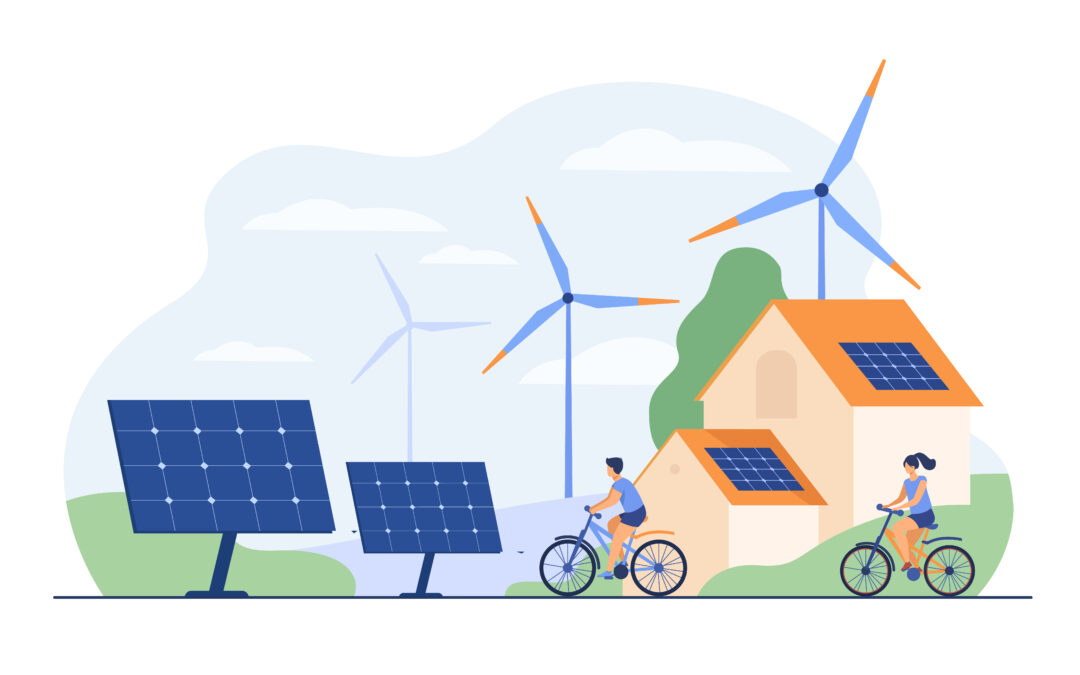
Furthermore, ESB Networks promoted higher usage of electric vehicles and e-bikes. Together with support from the City Council, this company installed several charging points around the city. There are additional plans of adapting these stations for the usage of green energy. (photo credit: pch.vector/Freepik)